
The European Commission has launched a 12-week public consultation on possible minimum performance standards for data centres in the EU. The Commission states that the feedback will inform preparatory work for a legislative proposal planned for Q2 2027, and that stakeholders can submit input until 14 December 2026.
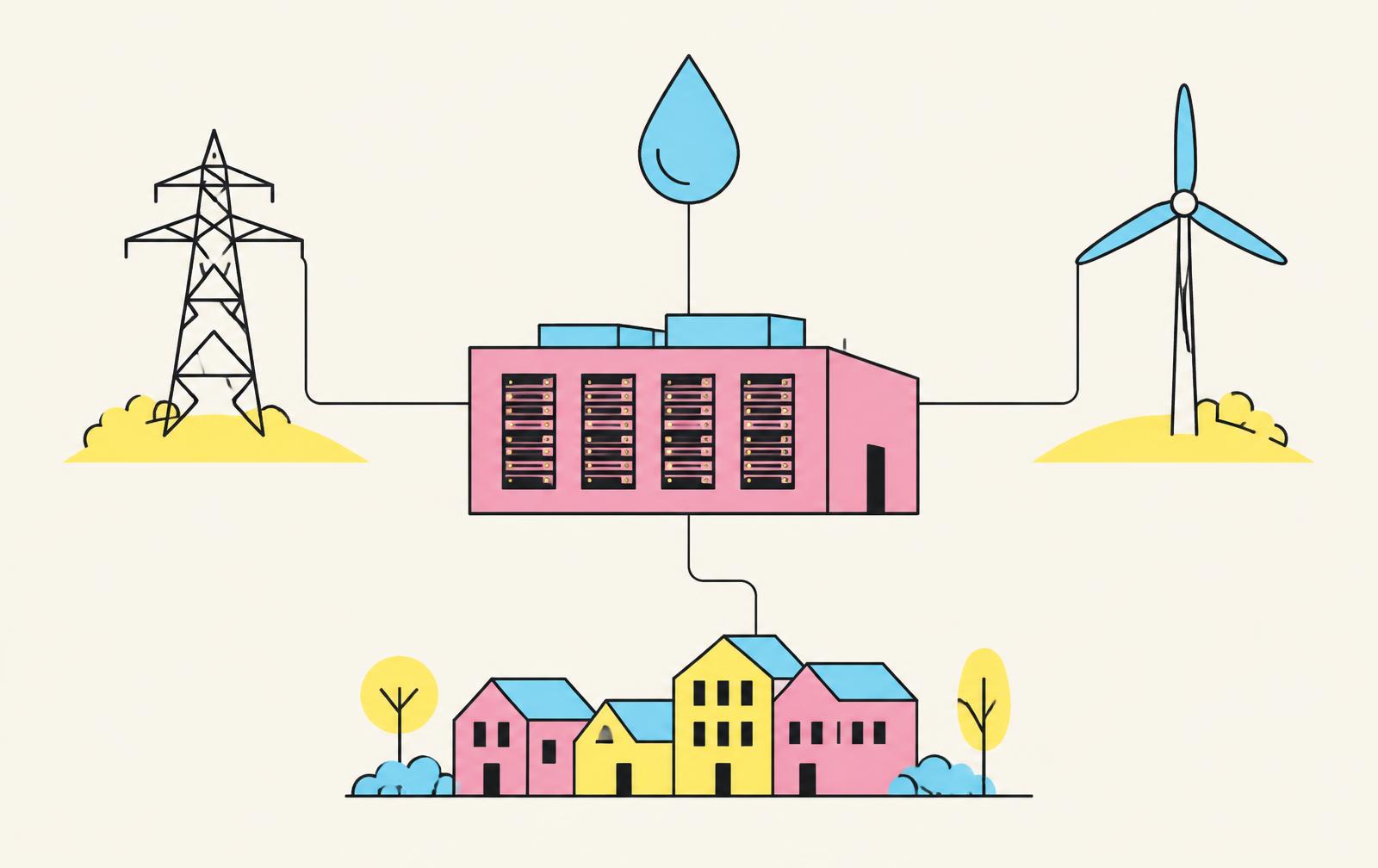
The Commission also highlights that the expansion of data centre capacity creates challenges not only in terms of energy consumption, but also for electricity grids, carbon emissions and environmental resources such as water.
This is where the discussion becomes particularly important. Europe wants significantly more digital infrastructure.
The challenge is therefore not whether Europe needs data centres. It is how we make sure that the data centres we build have the lowest possible negative impact on the environment across their life cycle, bring economic value to the local communities in which they operate, and create a positive social impact.
Measuring what matters
Europe already has an important foundation. Under the EU reporting framework for data centres, established through Commission Delegated Regulation (EU) 2024/1364, sustainability and energy-performance reporting includes indicators such as:
- Power Usage Effectiveness (PUE) – how efficiently energy is used within the facility
- Water Usage Effectiveness (WUE) – the relationship between water use and IT energy consumption
- Energy Reuse Factor (ERF) – the extent to which energy from the data centre is reused
- Renewable Energy Factor (REF) – the share of the data centre's energy associated with renewable energy
These are important metrics. But as Europe moves from reporting performance to considering minimum performance standards, dcently believes there is an opportunity to ask a broader question.
dcently's perspective
What does a truly sustainable data centre look like?
Energy efficiency is clearly part of the answer. But should sustainability performance also consider how a data centre interacts with the systems around it? The sections that follow are dcently's questions for the discussion — not a description of what the EU has decided.
Infographic
From facility performance → to system performance
Sustainable data centre performance needs to be measured at system level — not only facility level.
Facility performance
Current / established performance indicators (EU 2024/1364)
PUE
Power efficiency
WUE
Water efficiency
ERF
Energy reuse
REF
Renewable energy
Essential metrics — but not the full picture.
System performance
Questions dcently believes should also be part of the discussion
- Grid flexibility
- Renewable integration
- Water context
- Embodied carbon
- Circularity
- Community impact
How the data centre interacts with the wider system around it.
Energy and the grid
EUThe Commission explicitly identifies electricity grids as one of the challenges connected to growing data centre capacity (European Commission).
dcently asks
Should we look only at how much electricity a facility consumes – or also when it consumes it, what type of energy it consumes, its ability to provide flexibility, its contribution to grid stability and its ability to support greater integration of renewable energy?
Water
EUThe Commission also specifically highlights water as an environmental resource affected by data centre growth (European Commission).
dcently asks
WUE gives us an essential indicator, but local context matters. A litre of water used in a water-stressed region is not necessarily equivalent to a litre used elsewhere. Should water availability, water source, climate and local ecosystem impact also form part of how performance is assessed? And how do we factor in water use from the full value chain of the data centre, including electricity production?
What do you think we should measure?
Add your perspective to the dcently Sustainability Pulse 2026.
Heat reuse
dcently asks
Recovering heat is one thing. Having infrastructure and demand that allows the heat to create genuine value is another. How should we evaluate the practical potential and actual utilisation of waste heat?
Carbon
EUThe Commission explicitly includes carbon emissions among the challenges associated with data centre growth (European Commission).
dcently asks
Operational efficiency matters, but data centres are also physical infrastructure. Should embodied carbon from construction, equipment replacement and the wider supply chain increasingly form part of our understanding of performance? We already have operational CUE (CO₂e per kWh of IT load). Should we also include a CUE for scope 3?
Resources and circularity
dcently asks
Servers, cooling systems, batteries, UPS systems and other equipment contain significant amounts of materials. How should longevity, repairability, reuse, refurbishment and end-of-life management be reflected? How can we increase circularity for data centres in the EU?
Resilience and resource efficiency
dcently asks
Can we design facilities that achieve resilience without unnecessarily oversizing energy, cooling and backup infrastructure?
Sustainability does not stop at the data centre fence
Data centres exist within communities. They compete for – but can also contribute to – electricity infrastructure, water systems, land, skills and local investment. This leads dcently to believe that long-term sustainability should also include questions such as:
- local value creation
- transparency
- community engagement
- infrastructure development
- societal benefit
- trust and acceptance
In other words, technical efficiency and licence to grow are becoming increasingly connected. This is why we believe the discussion around minimum performance standards needs input from the whole data centre ecosystem. Not only operators.
We want to hear from:
- Data centre operators
- Energy companies
- Municipalities
- Policymakers
- Equipment manufacturers
- Infrastructure providers
- Investors
- Construction companies
- IT buyers
- Researchers
- Sustainability professionals
- Citizens
Different stakeholders see different parts of the system. And that is exactly why their perspectives matter.
What do you think should define a sustainable data centre?
The European Commission is now considering minimum performance standards for data centres. At dcently, we want to make sure the discussion includes perspectives from across the full ecosystem — not only one part of the industry.
What should be measured?
What should minimum performance standards address?
And what are we currently missing?
The easiest way to make sure your perspective becomes part of the picture is to take part in the:
dcently Sustainability Pulse 2026
It only takes a few minutes. Your perspective will help us build a broader picture of what sustainable data centre development should mean in Europe.
dcently will use insights from the Pulse, together with feedback gathered from stakeholders across the ecosystem, to inform our contribution to the European Commission consultation.
The European Commission consultation remains open until 14 December 2026. Because if Europe is going to define what good data centre performance looks like, we should make sure we are measuring:
what actually matters.