
What makes a data centre sustainable?
When we asked this question in dcently Pulse, we expected to hear about energy efficiency, renewable electricity, cooling technologies and carbon emissions.
And we did. But we also heard something much bigger. One respondent put it this way:
“We should stop measuring data-centre sustainability only by facility efficiency and start evaluating the entire infrastructure value chain.”
Another challenged us to think about whether data centres can meet society's demand for computing without compromising the future availability of water, energy, land and ecosystem services.
And one response raised a question that deserves far more attention:
“A sustainable data center must be transparent not only about its environmental impact, but also about what its computing capacity is used for and what societal value that use creates.”
What if we've been asking too narrow a question?
The industry has made significant progress on energy efficiency, renewable electricity and cooling technologies. And these efforts matter.
But a data centre can improve its PUE while its total electricity consumption increases. It can create jobs without building lasting local opportunities. It can use low-carbon electricity while placing additional pressure on an already constrained grid.
And it can provide enormous computing capacity without necessarily understanding the societal value that capacity enables.
None of this means that data centres are inherently good or bad. They are essential infrastructure for an increasingly digital society. But their rapid expansion makes it more important than ever to understand both what they take from society and what they contribute.

Efficiency alone cannot answer that question.
So, what did we hear?
We asked a simple question in dcently Pulse: What must be true for a data centre to be considered sustainable? And the answers challenged us.
People didn't just talk about energy efficiency, renewable electricity or better cooling. They talked about human rights, local communities, natural resources, circularity and the value of the digital services that data centres enable. Some even questioned whether we are measuring the right things in the first place.
As we explored the responses, five themes began to emerge. Together, they have become the starting point for five guiding principles in the dcently ESG Playbook. Not five principles invented behind closed doors, but five ideas shaped by the voices of the data centre ecosystem.
And we're not finished listening. Here is where the Pulse is taking us.
dcently ESG Playbook
Five guiding principles, shaped by the Pulse.
- 1
Reduce environmental impact and advance circularity
- 2
Create lasting local and regional benefits
- 3
Enable valuable and responsible digital services
- 4
Take responsibility across the value chain
- 5
Measure, disclose and demonstrate
1. Reduce environmental impact and advance circularity
Efficiency matters. But reducing environmental impact requires looking beyond efficiency ratios.
A data centre might become more energy-efficient while consuming more electricity overall. The same applies to water, materials and other resources. And where an impact occurs matters just as much as how much we use.
A cubic metre of water consumed in a water-stressed region can have very different consequences from the same amount used where water is abundant. Land use, biodiversity impacts and pressure on local energy systems also depend on the conditions in which a data centre operates.
We need to understand both absolute impacts and their local context, across the entire lifecycle – from raw material extraction and equipment manufacturing to construction, operations, upgrades and end-of-life.
That means addressing greenhouse gas emissions, energy and water use, pollution, land use and biodiversity. It also means designing for longer equipment lifetimes, reuse, repair, refurbishment and circular material flows.
The question is not only how efficiently a data centre operates, or how many resources it consumes, but what consequences that consumption has – wherever those impacts occur.
2. Create lasting local and regional benefits
What should a community gain from having a data centre nearby? More than a construction project and a promise of jobs, we would argue.
Data centres can create lasting value by employing local people, engaging local contractors, investing in training and personal development, and working with universities, schools and research institutions.
They can contribute to shared infrastructure, from roads and electricity networks to grid flexibility and useful waste heat. They can support local sports clubs, community initiatives and opportunities for young people. And they can involve their neighbours in decisions that affect them.
But these contributions should not be defined by operators alone. What does the community actually need? And what will be better because the data centre is there?
A meaningful contribution might look different in a small municipality, a growing industrial region or a major European city. The benefits should be relevant, measurable and lasting. And they should not be used to excuse negative impacts or replace basic responsibilities such as fair treatment of workers and suppliers.
We believe this is an area where data centres have an opportunity to do much more than simply minimise harm.
3. Enable valuable and responsible digital services
This is perhaps the most challenging principle. Because it asks a question we rarely hear in discussions about data centre sustainability:
What is all that computing and storage capacity actually for?
Data centres enable scientific research, healthcare, education, communication, public services, financial systems and increasingly artificial intelligence.
They are essential to modern society. But not every digital application delivers the same benefits, and more computing does not automatically mean more societal value. Digital technologies can also have negative consequences, including environmental pressures, privacy risks, exclusion and harmful applications.
We are not suggesting that every data centre operator should decide which digital services society is allowed to use. But we do believe the industry needs a broader conversation about the purpose and consequences of the infrastructure it is building.
That conversation must include operators, customers, technology providers, researchers and policymakers. If we want to understand the sustainability of digital infrastructure, we cannot completely separate it from what that infrastructure enables.
4. Take responsibility across the value chain
A data centre's responsibilities do not stop at the facility boundary.
Behind every facility are global supply chains, construction projects, equipment manufacturers, contractors, workers and communities.
Human rights, occupational health and safety, fair working conditions, responsible sourcing, ethical business practices and sound governance are fundamental. So are identifying and managing risks, including climate-related risks, throughout the lifecycle.
A company cannot claim meaningful progress simply by improving the performance of its own operations while overlooking significant risks and impacts elsewhere in its value chain.
Responsibility must follow the impacts, not just the ownership boundaries.
This requires due diligence, clear expectations of suppliers, accountability and collaboration across the ecosystem.
5. Measure, disclose and demonstrate
Perhaps one of the clearest messages from the Pulse is that we need to get better at showing what progress actually looks like.
The industry has many metrics, frameworks, standards and commitments. But are we measuring the things that matter most?
PUE tells us something important about facility energy efficiency. It does not tell us the total environmental impact of a data centre, the conditions under which its equipment was produced or the value it creates for society.
We need credible data, meaningful targets, transparent reporting and independent verification where appropriate. We also need to distinguish between relative improvements and absolute impacts, between promised benefits and delivered outcomes.
And when we communicate progress, our claims should be specific, supported by evidence and clear about their limitations.
The question is no longer simply what a company promises to do, but what it can demonstrate.
One system. Shared responsibilities.
These five principles are connected by something even more fundamental: a systems approach.
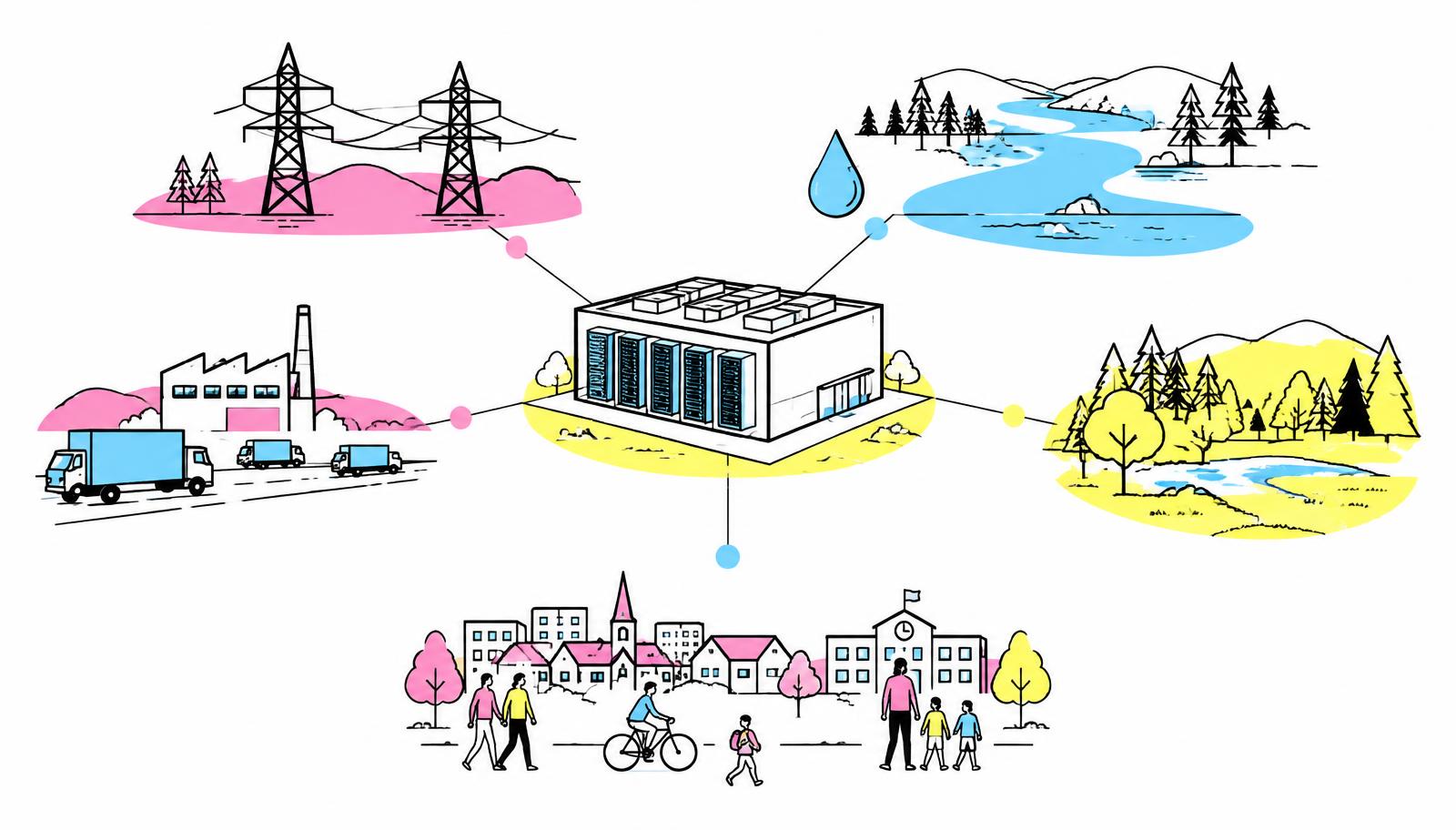
Data centres do not exist in isolation. They are part of energy systems, water systems, global supply chains, local economies, communities and an increasingly interconnected digital society.
Looking at the entire lifecycle and value chain helps us understand dependencies and trade-offs that individual performance indicators cannot capture. An improvement in one area can create pressure elsewhere. A solution that works for one facility may not work for the wider system.
And no single actor can solve every challenge alone. Operators, developers, equipment manufacturers, customers, investors, energy providers, public authorities and communities all have different responsibilities and opportunities to influence outcomes.
Shared responsibility, however, must never mean that nobody is accountable.
We also need science, credible data and continuous learning. The Pulse gives us valuable perspectives, but developing a useful playbook means bringing those perspectives together with research, existing standards and practical experience.
We're building this together
These five principles are not a finished standard. They are the starting point for the dcently ESG Playbook, shaped by what people across the data centre ecosystem have told us so far.
And the conversation is far from over. We want to understand where expectations align, where the difficult trade-offs lie and what the industry should prioritise next.
We want to hear from operators, suppliers, investors, policymakers, researchers, customers, communities – and those who question whether the industry's current direction is sustainable.
Especially those who disagree with us.
Because if we are serious about defining what better data centres should look like, we need more than the perspectives of those already in the room.
So, what do you think?
What must be true for a data centre to be considered sustainable?
What are we missing? And what should the industry be able to demonstrate, rather than merely promise? Take part in dcently Pulse and help shape the ESG Playbook for better data centres.
Pulse by pulse.